A.T. Johnson Class of ‘70 Gathers for 2nd Reunion

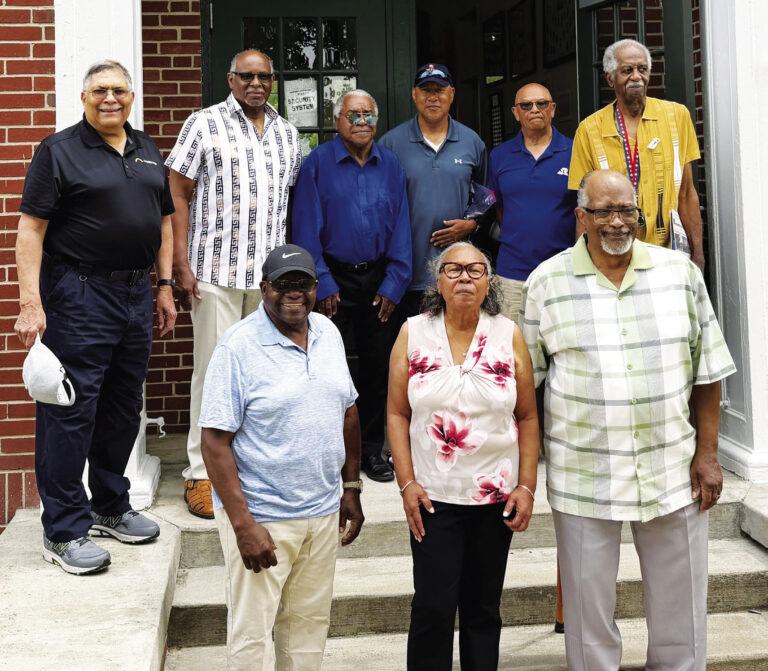
The last graduating class from A.T. Johnson High School started holding reunions last year and were determined to make sure that they didn’t wait another 55 years before gathering again. The class of 1970 held a reunion last weekend at the former Black high school constructed in the days of segregation.
Virginia was a state very resistant to desegregating schools. When integration began in Westmoreland County, initially students got to pick which school they went to before everyone was consolidated.
Once the high school classes were consolidated into Washington & Lee High School, A.T. Johnson continued life as a middle school before it was eventually closed for good. Nowadays the additional structures next to it serve as county offices and a YMCA, while the original structure is a museum overseen by Marian Ashton, who graduated from the school in 1968.
As everyone gathered in the school’s auditorium hall, Manny Tate, one of the chief organizers of the reunion, said it is “an interesting time to be the last class to graduate from the building before everything was finally integrated.”
Ashton had similar feelings. Although she was not part of the last class to graduate from A.T. Johnson, she left its halls only a few years before Tate.
“I think it was exciting to know that we were one of the last,” Ashton stated. “The fact that we knew the school was closing was kind of exciting in one way and disappointing in another, because when we left, we didn’t know what was going to become of this school, and we were afraid the place would be closed down and demolished.
“What we were looking forward to though was being able to say we were totally equal now. Even Brown versus Board couldn’t make us equal, because we were already far ahead of some of the other counties before Brown versus Board came into play. Merging the schools just put us on a level playing field, so to speak.”
Ashton emphasized the importance of the school and what it meant to the students that were educated in its rooms.
“The thing that really excited us was that we could now show everybody how adept we were at everything. We truly thought we were the best of the crop. Some folks looked down on Black schools as inferior, and we wanted to show that wasn’t true. We were able to set out and do that as we went through the County, but now, to be sitting in the same classroom, we could actually prove that we were and always had been ready for anything.
“Learning was not optional here,” Ashton continued. “Everyone felt the same way here. This was the place where foundations were laid. It wasn’t so much that it was an all‑Black school, but rather that it was an all‑Black school that did not take no for an answer. We were not just making do, we were reaching for the stars, and our teachers made sure we realized that we could accomplish anything we thought about.”
Ashton would elaborate later on the feelings from welcoming the last class to graduate from A.T. Johnson back in, and the importance of the building and its place in history.
“It is so wonderful – makes my heart smile. This school, built by our ancestors in 1937 for youth of African descent with a major charge – go forth understanding failure is not an option.
“This 1970 class returns with receipts showing they continued the journey mapped by others long before 1954 – long before the Supreme Court made Brown versus Board of Education a household topic of conversation — making the hearts of many have palpitations. This was the first class to open the doors of the new ‘Colored’ elementary school – Cople‑Montross Elementary School.
“So, the class that closed the doors of the one‑ and two‑room schools and segregated public schools in Westmoreland County, it was only fitting that they would also be the last class of the Armstead Tasker Johnson High School – carrying the torch of the unspoken charge with an added responsibility — as the last chapter in the book of the A.T. Johnson High School – secure the impactable legacy of the segregated school system into the sunset of greatness.
“This class of 1970 afforded opportunities never before available – the Civil Rights movements opened doors previously boarded and locked that even the keeper of the keys could not open.
“Today as Stratford Hall – the Home of the Lees – celebrates the 250th Anniversary of America, this class is a testament to what our foreparents fought so hard to capture – an educational opportunity – they, many uneducated, knew the keys to greatness was something many called a right.
“So how do I feel – proud to be amongst the best and brightest to walk the hall of A.T. Johnson High School – filled with pride that we have a school home/museum to return to.”
James Long coached basketball at A.T. Johnson and broke additional ground by starting one of the first African‑American football teams on the Northern Neck. Long coached at the school for close to 20 years and looked back on those days fondly as he reminisced with his former students.
“Coaching was fantastic here,” Long commented. “Students were very disciplined and parents would back you up. There was even a curfew. We won many games, and the teachers didn’t have problems with the kids like what we have now. Getting the parents involved made a huge difference.”
Long would eventually be scooped up as a coach by Northumberland County’s Public Schools.
A number of folks who had been present last year were unable to be here this year. Although the gathering was considerably smaller, the classmates have no plan on stopping their now‑yearly reunions.