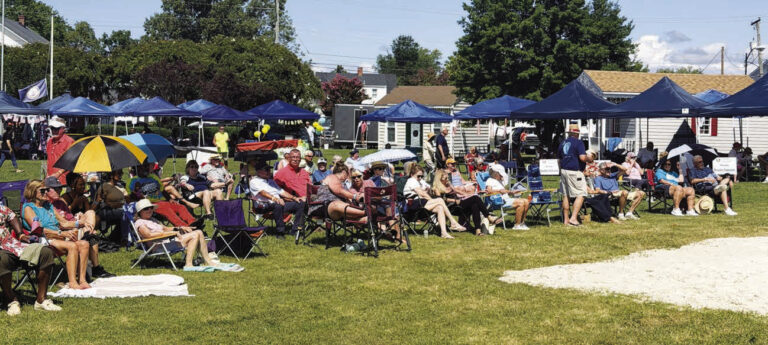
Commemorating Juneteenth at growing Colonial Beach event

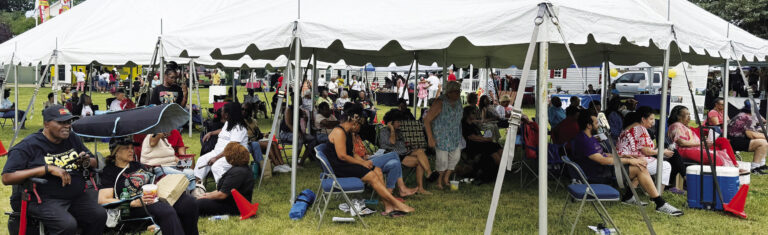
For the last five years, since Juneteenth became a federal holiday in 2021, there has been a gathering in Colonial Beach at Town Hill Park. Over the years, attendance has grown as more vendors and local institutions set up their tents.
Known to some as Emancipation Day, Juneteenth began in Texas near the end of the Civil War, when the last enslaved people there were informed of their emancipation, marking the end of “the peculiar institution” in the South. It has since become a celebration of culture within the African American community and a look forward to that “more perfect union” referenced in the Constitution.
Colonial Beach celebrated the event not just with vendors, speakers, and music, but also with raffle tickets for gift cards from various local restaurants, including Ice House and Riverboat on the Potomac.
The Dashiki Book Club offered several on-stage readings, from essays to poetry, while Jennifer Nelson belted out spirituals that lent credence to the old line about music soothing the savage beast. The Mount Hope Anointed Dance Ministry performed, and Ken Crampton and Amani Konan filled the air with the rhythm of African drums.
The real highlights came from the speakers—from Reverend Carolyn Fisher and Marian Veney Ashton, director of the A.T. Johnson Museum, to local legends such as Melinda Pierce and not-so-local legend Gary Flowers, who had brought down the house during his previous visit in February.
Ashton gave recognition to the elderly among those gathered, specifically those who had lived more than nine decades and the many momentous occasions they had witnessed. She opened her remarks with a recitation of “Still I Rise,” a poem by Maya Angelou.
“That is a powerful poem, and I thought that no other poetry I have read speaks to the elderly quite like Maya Angelou,” stated Ashton. “Today, we honor lives that have spanned ninety years of witness, remembrance, endurance, and stewardship. Ninety plus years of the two-hundred-and-fifty years of America. They have lived through times when freedom expanded, voices grew stronger, and doors that were once closed began to open—and through it all, they have carried wisdom, dignity, and strength.
“Their lives stand as proof that history is found not just in speeches, laws, and landmarks, but in the steadfast endurance of people who kept going, kept building, kept believing, and kept making room for others. Because of their witness, Westmoreland and the wider world became softer, gentler, and more open to the possibility that more people might share in the best America has to offer.
“These ninety-year-olds—and one who is one hundred and seven—are living bridges. They have witnessed changes that many of us only read about. They saw America through seasons of struggle and hope. Their lives remind us that progress is possible, even when it feels slow, and that endurance matters,” said Ashton.
While the list of individuals over 90 years old in Westmoreland County totaled about 400, fewer than a tenth were able to be honored. Those recognized included Mildred Ashton, Dorothy Young Ball, Dorothy Ball Jones, Harry Coleman, Edna Crabbe, Martha Dixon, and Daisy Howard Douglas, along with her husband.

“These people have shared in the Great Depression, the Virginia racial laws, and unequal schooling,” Ashton noted. She spoke further about what the elders had seen throughout the 20th and 21st centuries—from the slow march of desegregation to multiple wars, Brown v. Board, Loving v. Virginia, the Civil Rights Act, and countless other moments in history, all the way to the election of President Obama, the recognition of Juneteenth as a paid holiday, and the construction of the new high school in Westmoreland. Ashton then turned back to the honorees.
“These honorees have witnessed a century of faith, struggle, perseverance, and grace. They remind us that progress is not abstract, but personal. It is carried in memory, protected by courage, and passed on by example. To these honorees—you are not only witnesses to history, you are a living testament to it.”
Melinda Pierce, a force of nature in her own right and one of the key members of the Juneteenth Committee, spoke about the importance of history and passing it down to the next generation.
“History is not taught like it used to be. Younger people used to sit at home and listen to their grandparents talk about what they went through,” said Pierce. “That doesn’t happen much anymore, and that’s why things are changing—and not for the good. We have to keep fighting, keep speaking truth, keep pushing forward, and keep loving one another.”
Pierce read an essay from a student who had participated in a contest where children wrote about their vision for Colonial Beach.
“To us, Black History Month is not about the people that TV honors,” the essayist wrote. “It’s about honoring the free Black men who bought this land from James Monroe, and the Black men and women who turned their blood, sweat, and tears into transforming the farmland into a thriving Black community. This was before the Town of Colonial Beach, the Playground on the Potomac. Our history has been erased, but it still breathes life in the African-American Museum in Westmoreland County.”
The vision described in the essay was one rooted in access to opportunities such as STEM—not just for youth, but for adults as well. Pierce continued reading: “With the right tools, we can make Colonial Beach thrive again. We need our Town to give us access to trade skills and STEM programs locally so that people who have aged out can still have access to a better future. We need mentorship programs that understand us, access to get our GEDs, and mental health and addiction rehab locally.
“We need programs that bring us together so that we can actually talk and learn why we have these stereotypes about each other, and find ways to change so that we can learn that we all want the same things in life, and learn to put the violence down and pick up our brothers and sisters in love. Given the right tools, we will be that promised youth of the future.”
“I hope you carry this with you,” Pierce said as she closed her remarks, “because this Town needs things for its youth. A lot of people don’t have access to travel to places like Tappahannock and Fredericksburg.”
Cynthia Dunn spoke on diversity and equity, and inclusion programs were covered by Reverend Carolyn Fisher. But the absolute highlight came from the immaculate Gary Flowers.
“I’m not sure we celebrate Juneteenth so much as we commemorate it,” stated Flowers. “Where there are untruths, we don’t celebrate— we commemorate, because it is up to us to not lose our memory. This nation has given us good times, bad times, triumphant times, and tragic times. Today we are here to contemplate this strange word ‘freedom.’ There are fourteen days between Juneteenth and the Fourth of July. Those days may as well be fourteen different shades of freedom. What may be freedom to me might not be freedom to you, but our country, as an ideal, aspires to that strange word we call freedom.”

Flowers then unveiled what he had brought with him—something he and others from Richmond called “A Declaration of Liberation,” fresh from the printing press.
“Care as collective survival, love as a civic practice, a community-essential infrastructure for democracy. As the United States of America marks its 250th year as an independent nation, we choose not only to acknowledge the past, but shape the future. We choose to become builders of trust, equity, opportunity, belonging, cultural remembrance and sensitivity, and of futures rooted in dignity and rich opportunity for generations to come. This declaration is not a symbolic one alone, but a call to action.
“We invite organizations, institutions, and communities to sign on to these principles, in word and deed, and I pray that some of you, as individuals and as institutions, will—after today—sign on.”
The hope, Flowers noted, is that “by embracing collaboration as essential to growth, by telling the truth, by protecting human dignity, seeking equity, cultivating connection, advancing justice, uplifting our children’s potential, investing in people and places, and by participating in the continual work of liberation, may this declaration serve as a living, civic, and moral resolution for this generation and those to follow.”
“We, the people, declare ourselves responsible for one another. We, the people, declare liberation to be a shared responsibility, and we, the people, commit to living as though humanity belongs to all of us. We reject systems, policies, and practices that diminish human worth and encourage division to perpetuate inequity. We reject hatred, dehumanization, indifference, and the normalization of race-based policies. We believe that liberation begins within, through self-awareness, healing, and education. We believe that liberation flourishes with those who reclaim it and demand it. We believe that liberation begins with equal access and generosity of resources. We believe it begins with those who are self-aware.”
The declaration also spoke of a commitment to “truth over denial, repair over avoidance, connection over division, and stewardship of our very existence to justice over iniquity.”
“We honor our ancestors, leaders, organizers, artists, educators, healers, workers, and everyday people whose courage, resistance, labor, and imagination carried this nation to this point and will carry it forward.
“We recognize that liberation is not passive. It requires participation from all of us; it requires responsibility, and it requires that we confront things that are uncomfortable.”
Flowers ended his remarks by stating that this declaration of liberation “has been written not only for our African ancestors, but for those who are present today—Black, white, yellow, red, or brown—because at the end of the day there is only one race: the human race.”
He added, “We declare on this day, June 19th, 2026, that as we turn to each other and not on each other, we will live out what Dr. King called ‘that beloved community.’ But we’ll do something deeper than that—we’ll reach down to our humanity and see that, as scripture holds, red, brown, black, or white, we are all precious in God’s sight, and at the end of the day, it’s not about Black and white, but wrong and right.”
Reverend Cunningham gave the closing prayer and remarks. “Before you leave, hug somebody, shake their hand, and tell them, ‘I love you, and there’s nothing you can do about it.’”