New training program will boost sailor population at Dahlgren

Navy leadership is excited to have a new entity coming to Dahlgren, Community Planning Liason Officer Adam Lynch told the King George Planning Commission.
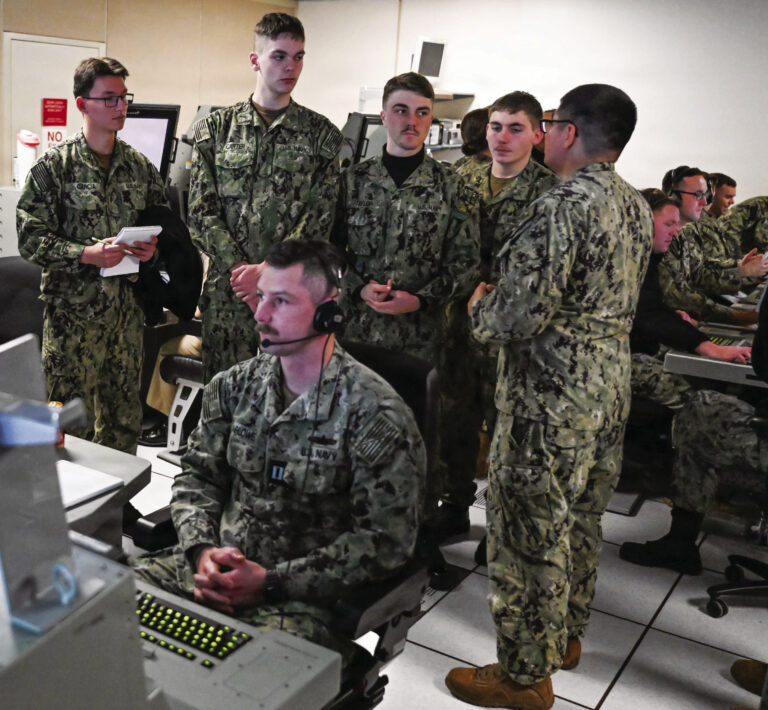
The Navy is moving its Aegis A School to the base bringing 500 additional sailors to the base when the transition is complete in 2030.
Aegis is the advanced combat system on warships that performs search, tracking, and missile guidance.
Currently, all the sailors who operate the system begin their training at A School in Great Lakes, then come to Dahlgren for C School, but the Navy is restructuring its training pipeline and consolidating both A School and C School at Dahlgren.
The Navy will not shift all students at once. The transition will ramp up over the next four years, Lynch said. But he did not know how many would come at any given time.
There actually won’t be more students coming, but the students who do come will be staying about twice as long, Lynch said. While C School students currently remain on base for about 9–10 months, sailors may average 18 months once A School is fully relocated to King George.
Most of these students will be single, junior enlisted sailors early in their careers. The Navy expects the majority to live in on base barracks, though some may choose off base housing and could bring families.
Commissioner Roger Kniceley asked what the county should expect regarding traffic impacts. Lynch referenced a document from SCSTC indicating that most students will not have cars, reducing off base traffic concerns.
To support the increased student population, the Navy is investing in additional barracks space. A substantial portion of the current hotel is already used as barracks. A new hotel is under construction, and oce complete, the existing hotel will be fully converted into barracks.
Chairwoman Denise Flatley urged the Navy to consider the impact of past cuts to MWR (Morale, Welfare and Recreation) funding, noting that long stays in Dahlgren can be “brutal” for young sailors without cars and with limited recreational options.
Lynch said that MWR funding allocations are tied to the number of active duty sailors on base. “So we’re hoping that as a result of this, we will have more active duty, which will lead to more funding to MWR.”
According to the Navy, they are accelerating the A School transition in part because of bottlenecks in the training pipeline.
Rear Adm. Greg Huffman, commander of Navy Education and Training Command , told USNI News that some sailors wait up to four weeks to move on to their A Schools, delaying their arrival to the fleet and contributing to manning gaps at sea.
The Navy has already begun testing the plan launching an A School pilot at Dahlgren last year, with the stated aim of delivering the highest level of technical training in the shortest time. By separating Aegis students into their own A School, they can receive essential SPY radar fundamentals earlier in the training pipeline, the Navy said.
In March, 23 students graduated from the A School pilot at Dahlgren.