Joint session held to address comms tower
The potential construction of a communications tower in Colonial Beach and the zoning text amendments to make it possible have been working their way back and forth between the Planning Commission and Town Council for many months.
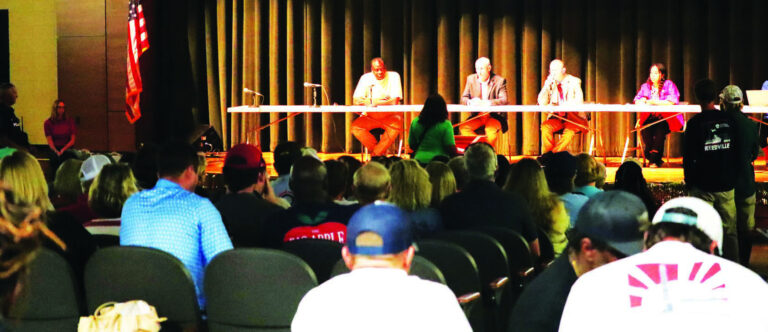
Given the number of questions from the public, it was decided that a joint session should be held to present the matter and hold public hearings that would allow everyone to be in one place and get everybody on the same page.
The three public hearings were presented together and pertained to the matter of constructing telecommunications facilities within certain portions of the town, particularly a telecom tower on a parcel of land off New Monrovia Road.
“People have asked why we’re doing this the way we are,” stated Angela Lawrence, Colonial Beach’s director of the Department of Planning & Community Development. “The zoning ordinance only permits communication facilities or towers in an A1 Agriculture district. There are currently no properties in town zoned that way.”
Essentially, the town would have to either rezone a property into agricultural use or come up with a zoning text amendment that would allow a tower where appropriate in a commercial district, which has to be initiated by the Planning Commission or Town Council. A variance through the Board of Zoning Appeals was not a viable option due to state and local codes.
The first text amendment, 26-01, would amend the zoning code. The second text amendment, 26-02, pertains to permitting and regulations, with an eye toward potential future projects. Specifically, while telecommunication towers would be permitted in a C-1 general commercial district, they must be located no less than 100 yards from residential districts, schools, parks, and shorelines.
When those parameters were compared to the town’s property maps, there was one particular patch of ground that could hold a telecom tower: the plots surrounding the Food Lion at the Beach Gate Shopping Center. There was also a patch near the Fas Mart, but the plot of permitted ground was so small that VDOT would probably say it’s a hard no if someone tried it.
A major concern that was addressed was signage. No advertising of any kind will be allowed on a telecom tower or other related facilities. The only exception is a sign with the tower owner’s emergency contact number. Even then, the sign itself cannot exceed 4 square feet in size and will be located on the security fence.
When the time came for public input, Colonial Beach resident Pam Tolson was the first to chime in, supporting the amendments.
“I’m begging you, please pass these amendments,” stated Tolson. “Having sat on the Planning Commission, I understand what you’re trying to do and need to do in order to change the language, but speaking as a small business person who relies on the internet every day to keep our business open, I fully support what you’re trying to do. I know these towers aren’t beautiful, but I also know that without them, this town will not grow, and the businesses that are here will be struggling every day to survive.
“When I moved here in 2013, I sold my business association management company in Illinois, and I brought two clients with me. Within three years, I had to give up the fact that I can never depend on whether the internet was going to work or my cell phone was going to even record the messages. All this time, I thought my biggest issue was going to be health care for my eighty-seven-year-old mother, and now here I am all these years later—I go into Colonial Buzz, our business, and the Brewery, and we wonder every day if the internet is going to be working that day.
“We probably have only one in four customers that pay with cash. Everything else is by credit and debit cards, and when you’re in the middle of a sale and the internet goes down, it may come back in a few minutes, but you end up giving away products because you’re not going to take the product out of peoples’ hands.
“The bottom line is, with every single sale we make, it is important for us to be able to keep our business up, paying our food taxes and paying our staff, and while these towers are not pretty, I understand there are some things that can be done. This town is not going to keep growing and giving the services that we all demand—streets, garbage, water that works—without it.”
Tolson ended her remarks with one final set of questions, asking the council and Planning Commission, “How many times do we have people come into a business like the Colonial Beach Brewery and ask, ‘Do you have any internet? I’m staying at the Airbnb down the street, and it’s not working.’
“That is the first thing they want—not coffee, not even beer. They want internet service. That is another service we provide to this community to keep the tourists happy. The Brewery and a number of other small businesses also plan events and rely heavily on being able to provide the movie, presidential speech, or whatever else that is being listened to without the internet going down.
“I appreciate the fact that you’re even looking at facilities. Where’s the best place to put this tower? I don’t care. My backyard’s available if you’ll let me. I’m that desperate because I rely on it that heavily.”
Another to chime in was Bob Christiansen, who noted the importance of good communications in a town like Colonial Beach, stating, “This particular town, being fairly remote from other business districts, depends very heavily on the type of communications we’re talking about.”
Christiansen continued, thanking the town staff for proposing what he called “a solution to a real problem in the town, and for showing the wisdom in having a conditional use permit.”
“This is just income coming to the bottom line of the town to help operate,” Joe Kelly stated further. “This is as much of a no-brainer as you can possibly make to help improve the economy of Colonial Beach and provide financing that is surely needed to help us make Colonial Beach affordable in the future.”
When the hearings were done, the Town Council adjourned its part of the joint session, while the Planning Commission went to work discussing and amending the proposals. After a lengthy discussion, both zoning text amendments and the conditional use permit were sent along to the council, along with a “Determination of Substantial Accord” with regard to the town’s comprehensive plan, placing the ball back in the Town Council’s court.