Worship Watch comes to Little Zion Baptist Church

Enough tragedies have happened in churches across the country that the public increasingly acknowledges that horrid things can happen in houses of worship. Instead of letting worries fester, First Sergeant Antwan Smith of the Westmoreland County Sheriff’s Office decided that keeping people aware and prepared was the best approach. Thus, the Worship Watch Program was born.
“The program is designed to strengthen communication, preparedness, and partnerships between local places of worship and law enforcement,” Smith commented. “We invite churches or places of worship to participate in this important initiative.
“The purpose of the Worship Watch Program is to help create a safer environment for congregations by encouraging awareness, sharing safety information, and building strong relationships with public safety personnel and neighboring faith communities.”
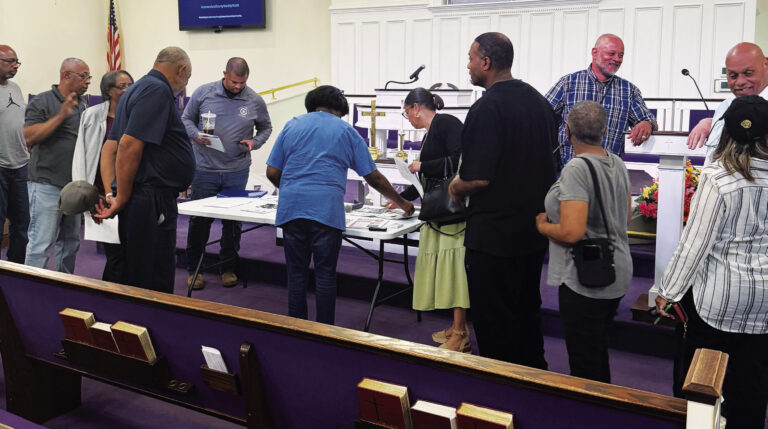
Smith started at Nomini Baptist Church and has been hosting regular meetings at different churches throughout the county. The most recent one, which took place on the 21st of May, was held at Little Zion Baptist Church, a stone’s throw from the Oak Grove intersection.
Originally, First Lieutenant Andrew Johnson of the Loudoun County Sheriff’s Office was set to be the guest speaker that night, but circumstances beyond human control prevented that. Fortunately, Smith was prepared and was able to get Master Detective James Belcher to give an address instead. He focused on how a church could potentially respond to an active shooter incident.
“My subject tonight is about protecting communities through proactive preparedness and robust law-enforcement partnership,” stated Belcher. “It’s a heavy topic, but critical, as we need to safeguard our places of worship against threats. If you watch the news for any amount of time in the last four years, I can think of at least ten church shootings that gained national notoriety these days. Sadly, it’s a fact of life these days; anywhere you go out in public—a grocery store, a school, a church, and so on—somebody with a gun that shouldn’t have one may show up to inflict a massive amount of violence.
“It’s a unique situation when it’s a church, because we have to balance with that open and inviting feeling. We want the community to come to church and be part of our organization, but at the same time, we have to think of what we can do to enhance security that might not be conducive to a welcoming environment.”
Belcher drew a line to church greeters as an example of this balancing act—not only do they foster that feeling of warmth and invitation, but this position also inadvertently makes them “the first line of defense.” “They’re your eyes and ears. They can get a feel for someone, and if that person gives them the cold shoulder on the way in, that’s a possible indicator that they should keep a closer eye on them. That’s a great frontline opportunity.”
Belcher spoke about the dynamics of stress responses. As a first responder of over 25 years, the master detective had a number of unique insights into the complications stress can inflict on people in times of crisis.
“In order to function under stress, we have to understand how the human body and mind act under extreme pressure, and in an active shooter event, that pressure will be even worse as your life is in danger,” noted Belcher. “A tactical plan is only as good as someone’s preparedness. Always start with a plan. When you go somewhere to eat, you may have noticed that if there’s a law enforcement officer there, they’re usually in a corner, away from windows, with their back to a wall. That’s part of being prepared and having that plan so that we can react.
“If your mind locks up, your body will follow. That’s the first part of a disaster response.”
The three stages were, according to Belcher, denial (where the brain might try to rationalize a sign of danger like a gunshot as fireworks touching off, essentially trusting but verifying), deliberation (and avoiding analysis paralysis), and lastly, the decisive moment, where things move to action. Survivors will have moved through the first two stages very quickly to get to the third stage in time to do an effective response, whatever it may be.
To help develop a better understanding of how people tend to act when in the line of fire, Belcher drew a line to “the human brain versus the lizard brain.”
The “lizard brain” is known for being reflexive and emotional. This is what’s known as the “fight, flight, or freeze” response, and often takes over when the more reflective or rational parts of our brain shut down due to extreme stress.
“If you don’t have that plan and training in place, your human brain will be unable to work through the stress load, and your lizard brain isn’t prepared, and it doesn’t know what to do except freeze. It only knows what it’s practiced, and having those plans in place ahead of time can help that part of your brain save your life and the lives of others. If you don’t have a plan in place, you won’t know what to do.”
The example drawn up by Belcher was a simple one—if something happens and a shooter incident is about to start, people’s first instinct is usually to head for the main exit. That’s all well and good, but suppose the gunman is coming in that way? Naturally, people start looking at alternate routes, whether it’s an emergency exit, through a stained-glass window, and so on. In short, security protocols and emergency plans must be kept simple since fine motor controls become nearly impossible under such circumstances.
“We’re not gonna take a key and lock a door; we’re gonna do something like grab a big object such as a table to block the door,” commented Belcher.
The foundation of readiness for these situations, according to Belcher, could be found in two things: strategic awareness and anticipation, explaining, “Preparedness requires a calm head and clear focus. By thinking ahead, we remove the element of surprise that attackers rely on. The core of security, meanwhile, is the ability to anticipate what occurs during an incident, both within yourself and the surrounding environment. The goal is not to panic, but to focus on the solutions needed to keep yourself and others safe.
“Violent attackers use that lack of planning to work to their advantage. They don’t expect a plan to be in place or for you to react. Most active shooters are cowards. That’s why they do what they do to begin with, and why most active shooters, once confronted, get hurt themselves or otherwise take their own life. So you get rid of that element of surprise by having a plan.
“The key point here is that anticipation is not paranoia. Paranoia is helpless fear, while anticipation is about evaluating the environment, noting the exits, and developing a plan of action before a threat ever materializes.”
The talk then turned to the three available options: running, hiding, and fighting. The first is the primary goal. The biggest tip Belcher had for that was what he called “scripting.”
“Practice ‘if/then’ scenarios in your head every time you enter a new facility,” he said.
Hiding comes into play if running is not an option. Silence phones, turn off lights, and stay away from doors. Hide somewhere with thick walls.
“Cover will protect you from a bullet; concealment just makes it harder for you to be seen. Most important of all, silence that cell phone. Don’t even let it vibrate,” he said.
Fighting back is the last resort, but when all else fails and lives are in danger, one must be prepared to throw hands.
“The sad reality is that in a situation like that, every time you hear a bullet fire, that’s a potential life being lost, and the next one could be yours. If you can’t run or hide, you have to fight.”
While some in such a situation may be lacking in weapons, it was noted by Belcher that being struck by a flung book to the face would still be an unpleasant experience. With the goal of such a response being to incapacitate or otherwise disrupt the attacker, Belcher noted that everybody would have to commit to what he called “maximum physical aggression.”
“The goal is to disrupt the attacker’s mental loop,” Belcher continued. “He’s not expecting someone to fight back. He’s expecting sheep, and if you’re in this situation, you have to be the sheepdog and stop them from attacking the flock around you. You have to have a mindset of ‘not today, not in my house.’ Hesitation is FATAL in these situations.”
“After the shooter is dealt with, you have to start saving lives, because EMS will not have shown up yet and can’t go in until we have cleared the scene and made it safe for them. It can be hours before that happens, so the first thing you have to do is stop the bleeding.”
Belcher pulled up § 18.2-283 from the Code of Virginia, which states: “If any person carry any gun, pistol, bowie knife, dagger or other dangerous weapon, without good and sufficient reason, to a place of worship while a meeting for religious purposes is being held at such place he shall be guilty of a Class 4 misdemeanor.” A Class 4 misdemeanor is punishable by a maximum fine of $250.
“If I’m carrying a gun in church and save a life with it, I’d take the fine any day,” commented Belcher. “It’s there for a reason, but keep that ‘without good and sufficient reason’ part in mind. In today’s day and age, I can think of all kinds of ‘good and sufficient reasons’ for having a good guy with a gun inside a church.”
According to Belcher, church leaders can explicitly authorize certain folks to be able to carry a gun. If such an authorization is obtained, Belcher noted, “there won’t be a judge or jury in the Commonwealth that would convict you. And if they do, I’m sure plenty of folks will help with the fine.”
The next Worship Watch meeting is slated for Morning Star Church on Zacata Road on July 16.