Roused by Danger: Stratford Hall opens new Gallery

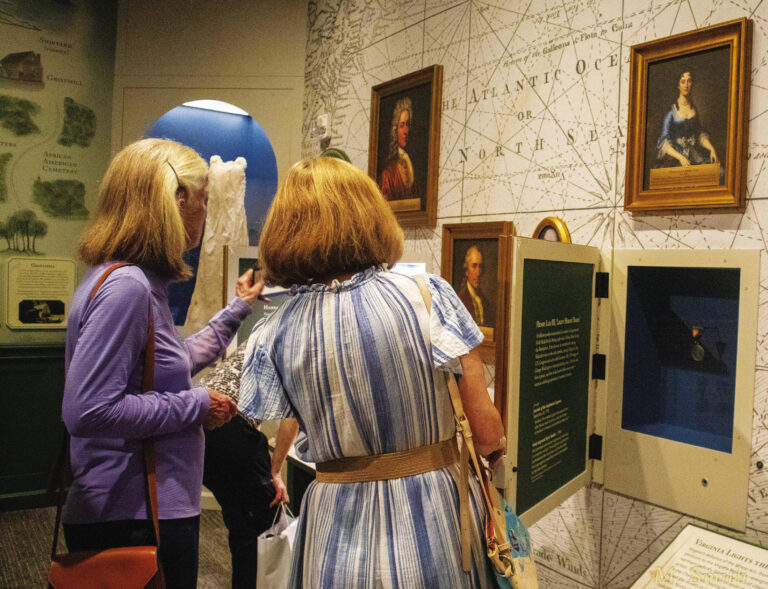
On the second day of Virginia Resolved, the 250th anniversary of the Lee Resolution, the Mary Belin DuPont Laird Gallery opened at Stratford Hall, highlighting its long, diverse history and a generation of revolutionaries.
With this orientation gallery, the primary focus is “to make sure people understand where they’re at, who was here, and who was responsible for the things that happened here,” said Kim Nelson, principal of The PRD Group, the design firm that brought the concept to life.
From there, the goal is to showcase the Lee family that actually lived at Stratford, “not so much the following generations because their stories are told elsewhere. We wanted to ground it back into the revolutionary story,” she added.
That aim is captured in the gallery’s theme “Roused by Danger,” the opening words from the Leedstown Resolves of 1776—a document whose larger than life pages greet visitors at the entrance.
Drafted by Richard Henry Lee, signed by three of his brothers—Thomas Ludwell Lee, Francis Lightfoot Lee, and William Lee—two cousins, and 109 other Virginians, that document was a pledge amongst them to go to any extremity to defeat the assault on their liberties.
But long before those Resolves, Stratford’s acreage was an ancient landscape, already storied, explained Dr. Gordon Blaine Steffey, Stratford’s VP of Research and Collections and the project lead.
Therefore, the story the gallery tells begins not in the 18th century but “in deep time” when the Northern Neck was sea floor. Stratford recognizes human presence on its grounds extends back thousands of years before the immigrant Richard Henry Lee I arrived in Jamestown, said Steffey.
Indigenous history and their ongoing presence are acknowledged. Further, the gallery recognizes “what was lost when this land changed hands,” he added.
The gallery also acknowledges the contribution of slaves “whose labor is etched into every acre of this land and under-herds every true story of Lee family achievement,” stated Steffey.
To the left of the entrance is a list of the known names of people enslaved on the property, making that a starting point in the experience.
“The enslaved community and the indentured servants—the Lees could never have done this revolutionary work had they not had the support of the everyday work being done by other people. So we need to always have that in mind,” said Nelson.
“We didn’t want to lose that story as part of the key reason the revolution could happen because it’s not just a bunch of very rich white men that were making things happen,” she added.
“It’s one of history’s difficult ironies that [the Lees spurred independence] from a home that was built and maintained by Africans and African Americans who were deprived of their liberty. But that irony doesn’t in fact diminish their achievement, it sharpens it. Our stories of freedom are forever entwined with our stories of unfreedom—That’s our legacy,” said Steffey.
One engaging way this gallery shows the entwined, overlapping vantage points is by literally offering visitors a seat at the table in four different scenarios from the 18th century.

Explaining how the selections were made, Steffey said inviting visitors to tea with Hannah Corbin Lee was an opportunity that clearly presented itself.
“That there was this woman in the 18th century asking, ‘what does no taxation without representation mean for me’… I feel we need to get that out because we have, at Stratford, the letter talking about this.”
And the fact that her brother agreed, “was incredible in 1778,” said Steffey. “No one was saying that. So it shows this family was conservative because they enslaved people but they were also progressive. It was a weird blend.”
Another scenario takes visitors to a kitchen table with a group of slaves. “Enslaved people aren’t often given voices. They can be given names, tasks, roles, but rarely do you see them have stories,” Steffey explained.
He jumped on the opportunity to change that but didn’t want some hollow ‘yes, master’ dialogue. “I wanted something that was real. I wanted to represent conversations that these people really would be having while they’re in the kitchen working.”
The other scenarios include a conversation among the Lee brothers and people around the table in a Westmoreland tavern. Together, that covers most strata of society, said Steffey.
“I love the complex story they tell,” said Phillip Reese, one of the gallery’s major supporters.
When Reese saw the gallery for the first time, the first words that came to mind were, “great pleasure and warmth.”
Pointing to pictures on the gallery wall, he said, “That guy right there is my ancestor and the guy next to him is my wife’s [ancestor]. And her grandmother is the one that secured the purchase of this place. She would be very proud.”
“It is incredibly appropriate that we open the Mary Belin DuPont Laird Gallery to the public today,” said Stratford Hall President Karen Daly. “On June 7th, 1776, 250 years ago, to the day, Richard Henry Lee offered his resolution in Philadelphia ‘that these united colonies are, and of right, ought to be free and indepenedent states.’” “Stratford Hall’s architecture, its archaeology, its artifacts, its agriculture all act as windows into the everyday lives of the Lee family, of the early American colonists, of the enslaved community, and of others who called this land home,” she said.
“This gallery is designed to orient every visitor who walks through our doors, to give context, to invite curiosity, to encourage them to think about their future and what a good use of their freedom looks like, and finally, to make clear that what happened here matters, not only as history but as a living conversation about who we are and what we owe to the past—all of the past,” said Steffey.