Windmill Point Campus Officially an Award-Winning Public Asset
Lancaster’s Windmill Point County Maritime Recreational Campus is officially an award winning site, earning two major accolades in just two months that recognize its environmental significance and value to the community.

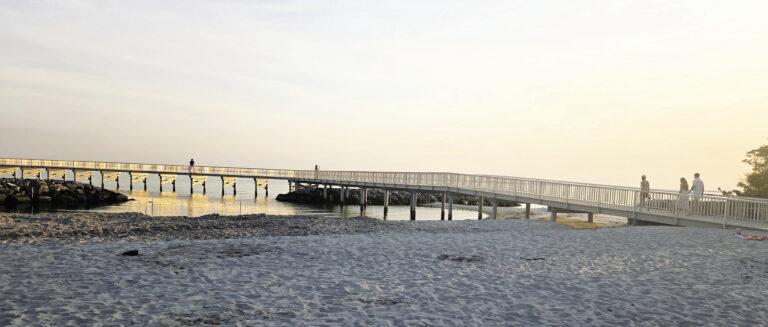
The project transformed a severely eroded shoreline into a revitalized public asset, expanding the county’s only public beach twentyfold and adding a 450 foot observation and licensed fishing pier, providing an accessible, free fishing option.

What had long been a site of loss — ranging from business to beachfront — has become an award winning example of restoration, public access, and environmental stewardship.

VACo Award

Last week, the Virginia Association of Counties announced that the Windmill Point Campus earned a 2026 VACo Achievement Award, which recognizes excellence in local government programs.

Of the 103 applications submitted statewide, Lancaster’s project was one of only 40 selected — and the only winner in the Northern Neck.

In its application, Assistant County Administrator John Bateman outlined why the county believed the project was worthy of recognition. Once home to a bustling beach, pier, hotel, restaurant, and the only marina with direct access to the Chesapeake Bay, Westland Beach had suffered severe erosion for decades.

The Windmill Point project directly addressed one of Lancaster’s most vulnerable coastal areas, protecting public and private property from the impacts of flooding and erosion. At the same time, it reopens the waterfront to residents and visitors, offering recreational opportunities for powerboats, paddlecraft, beachgoers, swimmers, birdwatchers, and recreational fishers. Local businesses and schools also have a new outdoor venue to showcase Chesapeake Bay living.

(Photo: M. Smith)

The campus also reflects Lancaster’s four economic pillars — agriculture, aquaculture, silviculture, and tourism — all of which depend on preserving open space and natural resources, the application noted.

The county purchased an oyster lease to support the pier installation and is partnering with Friends of the Rappahannock on an oyster restoration initiative connected to another park facility. Plans are also underway to restore a portion of the old lighthouse and install interpretive signage highlighting Windmill Point’s history as a destination for oyster watermen and its deep roots as a fishing community.

Financially, the project demonstrated strong value. A county study reportedly found that for every dollar spent, the public receives $3.22 in benefits, the application noted.

“Virginia’s counties continue to demonstrate that local government is where innovation meets action,” VACo Executive Director Dean Lynch said. “This year’s submissions reflect the creativity, leadership, and commitment county officials bring every day to solving real challenges and improving the quality of life for residents across the Commonwealth.”

Governor’s Excellence Award

In March, the Windmill Point Campus received the 2026 Gold Medal Governor’s Environmental Excellence Award. These awards, presented through a partnership between the Department of Environmental Quality and the Department of Conservation and Recreation, celebrate innovative efforts that improve Virginia’s environment.

“Protecting Virginia’s environment and promoting stewardship across the Commonwealth have impacts that will last for generations,” said Governor Abigail Spanberger. “I am honored to recognize this year’s winners for their efforts to protect Virginia’s environment and for inspiring others to do the same.”

The 11 winners and two honorable mentions were recognized at the Environment Virginia Symposium at Virginia Military Institute for their leadership in conservation, resilience, and preservation.

The award pamphlet noted that the Windmill Point Campus accomplished a variety of objectives, including rebuilding dunes and vegetative buffers and enhancing natural storm protection and ecological integrity.

These improvements “demonstrate how nature based solutions can protect infrastructure and ecosystems,” the document said. It added, “This initiative exemplifies replicable coastal resilience planning, combining habitat restoration, public access, and climate adaptation to deliver long term environmental and community benefits.”