‘Virginia Resolved’ Starts the Nation’s 250th Summer

Stratford Hall’s President announced the event will be an annual affair
Stratford Hall, one of the region’s crown jewels, boasting history, natural beauty, preservation, and a passionate staff dedicated to telling the countless stories linked to the home of the Lees, is no stranger to putting on something big. But this past weekend, the Hall and its staffers absolutely outdid themselves as they kicked off the summer with Virginia Resolved, a celebration of the Lees and their role in the adoption of the Declaration of Independence.
A celebration of the Semiquincentennial, this two-day extravaganza featured vendors, speakers, food trucks, and fireworks.
June 7th’s Significance
On June 7 of 1776, Richard Henry Lee, who was acting on a set of instructions from the 5th Virginia Convention, brought a resolution to the 2nd Continental Congress. The unprecedented contents declared, “That these United Colonies are, and of right ought to be, free and independent States… and that all political connection between them and the State of Great Britain is, and ought to be, totally dissolved.”
One month later came the adoption of the Declaration of Independence, cementing our intentions to break off from the most powerful empire the world had seen at the time.
Saturday Events
Saturday evening the crowd flooded in with folding chairs and blankets, claimed their spot, and surrounded the line of food trucks.
Attendees included members of the Westmoreland County Board of Supervisors, the National Society of the Daughters of the American Revolution, the Virginia Society of the Sons of the American Revolution, and Senator Richard Stuart.
Once the clock hit 8 p.m., Stratford Hall President Karen Daly welcomed everyone, kicking off a roster that included the United States Navy Concert Band and historical interpreter Frank Megargee as Richard Henry Lee.

“For many months, I feel like we’ve been getting ready for our nation’s semiquincentennial, working ceaselessly to plan and execute this monumental celebration of this place, and the Lee family members, who lived in these very rooms in that very house, through their selfless patriotism and service, helped create our brand new nation,” stated Daly. “What a debt of gratitude we owe to this founding generation for creating this great American experiment, now the longest-standing democracy in the world.”
Daly said, “As we commemorate the 250th anniversary of our nation and more Americans want to learn more about our past and engage in honest conversations with our struggle to create a more perfect union, Stratford Hall provides visitors with an inspiring, immersive experience of life in America’s formative years. It is truly one of the great houses of American history.”
She gave a brief overview of the Hall, from its construction in 1738 by Thomas Lee using enslaved labor and materials harvested on-site to its sheer scale.
“No other historic venue has so carefully preserved and presented two thousand acres of natural and human history. The Stratford Hall experience includes architecture, artifacts, archaeology, and agriculture that act as windows into the lives of the Lees, the early colonists, the enslaved community, and others that called this place home. The Hall’s history dates back millions of years, from the fossils on the beach to the Indigenous tribes, to the colonial period leading up to our American Revolution,” she said.
“Richard Henry Lee set in motion our nation’s independence two hundred and fifty years ago up the road in Philadelphia, and this weekend, we commemorate this incredible place here in Westmoreland County, where those foundational ideas of Liberty and Independence were born, where our revolutionary ancestors sought to create the more perfect union that we inherited and are still working toward today.
“Stratford Hall’s story is Virginia’s story, it is America’s story, and we are all part of it. Thank you all for joining us tonight to commemorate this pivotal moment in American history in support of our mission to give voice to Stratford Hall’s people, places, and past,” Daly said.
The first round of music from the U.S. Navy Band was followed by an interpretation of Richard Henry Lee, delivering both humor and profundity as he addressed those present, reading out the resolution that would mark the start of our breaking away from Britain.

“If anybody asks what in such a vast and diverse nation is to unite us, unlike the nations of Europe, which are commonly united by ancestry and religion,” stated “Lee,” “we will be united by our common belief that the people are best governed when they govern themselves, and that we shall be a country of laws of our own making, and not those made for us by others.”
The U.S. Navy Band performed a second round of music before the keynote speaker Carly Fiorina, the National Honorary Chair of the Virginia American Revolution 250 Commission, took the stage.
“How fortunate we are to be here tonight, almost two hundred and fifty years to the day that Richard Lee proposed a resolution of independence on June 7, 1776,” Fiorina said.
“The signing of the Declaration of Independence in Philadelphia was the end of one process and the beginning of another—to build a new nation.”
She mapped out points along the road to July 4th, 1776, from the Fincastle Resolutions of 1775 and Patrick Henry’s famous cry of “Give me liberty or give me death” to the contributions Virginia made to making the Revolution possible.
“We tend to overlook how fraught this period truly was, how consequential these actions were and the size of the risks taken. These colonists who spoke and fought for revolution risked everything. It is hard to fully grasp just how much they all stood to lose—property, stature, livelihood—all of it. They understood the Crown had the money, power, and troops to crush any resistance. The British Empire was the most powerful empire the world had ever known,” said Fiorina.
“We can convince ourselves that such courageous choices in the face of such personal danger and risk were made easier because there was such camaraderie and consensus among the actors, but that is not the full story.”
Among the bitter rivalries, Fiorina noted, was one between Thomas Jefferson and Patrick Henry, with the former considering the latter to be “a blowhard who nevertheless drew a crowd,” while George Mason and George Washington got into such a huge disagreement over creating a Bill of Rights that the bitterness led them to never speak to each other again. The divisions should have spelled our doom, but somehow, Fiorina noted, we managed to make it work against all odds.
“Great movements like this occur because common cause becomes more important than individual differences and disagreements,” continued Fiorina. “Great courage was required by Richard Henry Lee, George Washington, James Madison, George Mason, Jefferson, and so many others. All of these heroes had to set aside their own resentments and disappointments and commit themselves into common cause to something larger than any one of them.
“‘We hold these truths to be self-evident, that all men are created equal and endowed by their creator with certain inalienable rights, and among these are life, liberty, and the pursuit of happiness.’ These were clear, uncompromising, unequivocal words, and those radical words have inspired every generation, then and now, and every movement for human freedom and dignity ever since. The truth is the Revolutionary War was fought by people of every color, creed, and continent—fighting together on behalf of a perfect idea,” she said.
“Here in Virginia, it doesn’t matter if you speak English with a southern drawl or Spanish with a twang. It does not matter where you started or what you look like—if you believe in the promise of America, individual liberty, and equality before God, then Virginia is where you come from, because this is where those ideas were born and raised— where the idea of freedom became a nation destined to achieve it. We are all so fortunate to be here as Americans, and as Virginians, we are so privileged to be able to say to them: ‘America, welcome home,’” she closed.
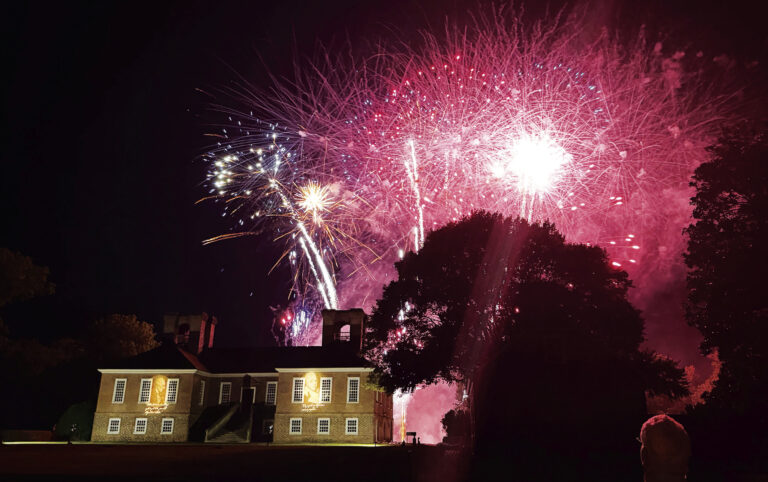
Saturday evening concluded with a gut-thumping fireworks barrage over the Great House, providing a perfect punctuation mark to the night’s festivities.
Sunday’s Events
Sunday was filled with activities. The Mary Belin duPont Laird Gallery was opened at the Visitor Center. At noon, during a citizenship ceremony, dozens of people from across the globe, including Egypt, India, Afghanistan, Cameroon, and Ghana, were officially welcomed as new citizens of the United States.
The 1st and 4th Continental Light Dragoons conducted cavalry drills on the lawn where the Sons of the American Revolution also conducted musket demonstrations. Shuttle buses taxied people down to the Gristmill and the mill pond. Colonial cooking, chocolate making, and Patawomeck eel pot demonstrations were held.

Westmoreland County Board of Supervisors Chairman Tim Trivett had a great deal of praise, stating, “Daly and her team did an outstanding job.”
“We started planning with our Northern Neck 250 partners back in 2021,” Daly stated. “We had a vision of a signature event to launch the summer that could tie into the Lee Resolution, and we piloted it last year with the citizenship ceremony. That proof of concept was a huge success—we had eight hundred people last year for that pilot event, and hadn’t even marketed it that heavily.”
This was a huge win from the tourism angle, Daly noted, because the timing of the event does not compete with other summer events, such as Memorial Day, the upcoming Colonial Beach Potomac River Fest, or the 4th of July.
“We’re still going to have events at all of our historic sites and museums on the Fourth, but this can be something distinct and launch the summer,” continued Daly. “What we’ve built with our regional partners was a tourism campaign to start someone’s summer where the Revolution started.
“This will now be an annual event on the first Saturday of June. We thought it was important that we have it happen on June 7th for the 250th, but moving forward it will always be the first Saturday of June.”