Delegate Kent Highlights Legislative Wins

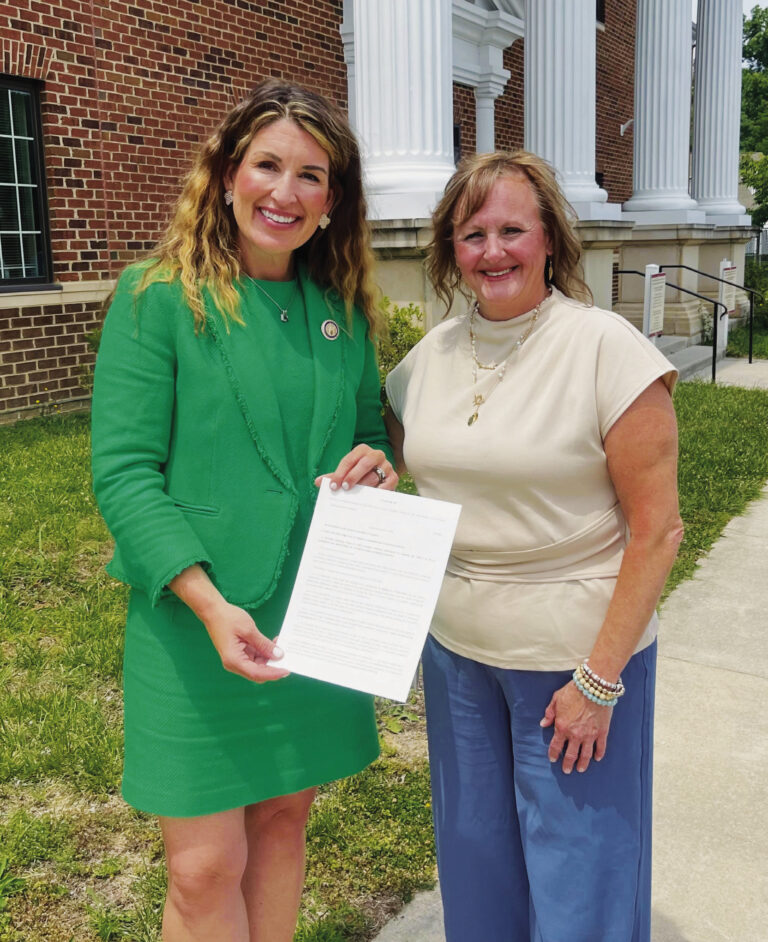
Delegate Hillary Pugh Kent has been making the rounds across District 67, providing an overview of the legislation she championed during this year’s General Assembly session.
Kent served on the House Education Committee and the Agriculture, Chesapeake Bay and Natural Resources Committee, and was also appointed to commissions for flooding and women’s health. She said those assignments embodied the focus of much of her work this session, and she was also focused throughout the session on ensuring they came out with legislation to “create a more affordable life for all Virginians.”
“I think part of my job as the representative for District 67 was to ensure public safety, education, our natural resources, health care, and doing whatever we could do to reduce government overreach were always top of mind in the bills that we put forth,” she said.
A point of pride, she added, is that many of the bills she carried originated directly from conversations with residents. “They are bills that came from voters of District 67,” she said. “I think that’s where government works best—where there’s a problem and we put forth legislation and can hopefully solve them.”
Nitrous Oxide
One of Kent’s successful bills targeted the growing recreational use of nitrous oxide— often referred to as “galaxy gas” or “whip‑pets.” She said she was hearing concerns from families across the district as products, sometimes flavored or sweetened, are increasingly marketed in ways that are persuasive to minors. Her legislation restricts sales under certain conditions to curb youth access.
Military Families
Kent responded to concerns from military families about school absenteeism rules. She pushed through a bill that allows students up to five excused absences without penalizing the school’s absenteeism metrics when an immediate family member is deploying or returning from overseas service.
Farm Vehicles
Farmers and a local sheriff approached Kent about Virginia’s prohibition on green lights for farm‑use vehicles, noting it creates a problem when farmers buy equipment from neighboring states that allow green lights.
“In Virginia, only amber lights are allowed,” she said. “Green lights are actually shown to be more visible and better to see, especially in the times that our farmers may be on the road at sunset and sunrise.”
Her bill allowing green lights on farm‑use vehicles takes effect July 1.
Placards for Watermen
Kent carried a bill aimed at reducing regulatory burdens on watermen. Current law requires placards on gear, but the markers often fail to hold up to sun exposure and rough water.
“We put in a bill to say that VMRC does not have to dispense and authorize the use of the placards as long as the ID is on a water buoy sphere,” she said. The change eliminates replacement costs for watermen—who previously had just 24 hours to replace damaged placards—and saves the state money by no longer issuing them.
Kent noted this is a bill that saves the state money, and it’s not often where legislation is passed that’s essentially giving money back to the state.
Aligning Land Use and Stormwater Rules
Another bill Kent carried addressed inconsistencies in mass land‑development regula‑tions, an issue raised by residents in Lancaster and Richmond counties. She said older poli‑cies caused the beginning stages of projects— erosion and sediment control—to be out of sync with end‑stage stormwater requirements.
Her legislation ensures that DEQ applications for large‑scale land projects align both ends of the process. The bill gives DEQ clearer authority to protect “our working lands and our working streams and rivers,” Kent said.
PFAS Testing
Kent introduced legislation to increase testing for PFAS and other contaminants at wastewater treatment plants.
“Normally in Virginia, the only requirement for more testing is the very large‑scale wastewater treatment plants,” she said. “My bill said, well, we really should test all of them all of the time.”
Her proposal was incorporated into a broader testing bill that ultimately passed.
CTE Pipeline
One of Kent’s long‑term priorities has been focused on Career and Technical Education (CTE) teachers.
“Something I’ve worked on for the past two years, something near and dear to my heart, is CTE teachers,” she said. Her bill allows individuals with CTE certifications and decades of industry experience—such as welders or electricians—to enter the class‑room at a pay level that reflects their professional background.
“If you’ve been in that position for 20 years, you can use that experience to then come in as a 10‑year teacher instead of a level one‑year teacher,” she said. The change aims to help schools recruit skilled tradespeople into teaching roles.
Bills She Opposed
Kent also highlighted legislation she did not support. With her focus on affordability, some were related to energy policy that would drive up costs for customers.
“A lot of them were based on tax increases to general commodities, goods, and services that do not make life more affordable for us or for any Virginian,” she said, noting that several were vetoed by the governor.
She cited proposed collective bargaining measures for public employees, which she said would have had “a massive fiscal impact on our state budget,” and the new paid family medical leave program. “That’s going to cost the state about $1 billion by 2029,” she said.